The Frick Collection and Frick Art Reference Library
The West Gallery of The Frick Collection

Home | Visitor Information | Collection | Library | FRESCO | Exhibitions | Concerts | Education | Special Events | Press Office | Museum Shop | Support | E-News

Special Exhibitions: Current
 
Special Exhibitions
Featured Exhibition
Current Exhibitions
Future Exhibitions

Past Exhibitions
2008  2007  2006
2005  2004  2003
2002  2001  2000
1999  1998  1988–97

Library Exhibitions

Search Our Collections

Search This Web Site

Gardens of Eternal Spring: Two Mughal Carpets in The Frick Collection
July 25 through October 1, 2006

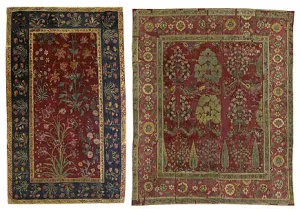
The two magnificent carpets on display in the Oval Room beginning July 25 are among the fewer than five hundred that survive from the court of the Mughal emperors. Woven in northern India in the mid-seventeenth century, these carpets were luxurious objects in terms of both the fabrics used to make them (silk and cashmere) and the artistically complex patterns that they display. The Frick carpets date from the reign of Shah Jahan (1628–1658) and were probably made at the royal factory in Lahore, one of India’s main cities for carpet production.

Northern Indian, reign of Shah Jahan (1628-1658), Carpet with Floral Pattern, first half of 17th century, silk and pashmina, 76 in. x 46 in. (193.04 cm x 116.84 cm), Henry Clay Frick Bequest, 1916.10.08   Northern Indian, reign of Shah Jahan (1628-1658), Carpet with Tree Pattern, first half of 17th century, silk and pashmina, 89 5/16 in. x 75 5/8 in. (226.82 cm x 192.02 cm), Henry Clay Frick Bequest, 1916.10.07
Northern Indian, reign of Shah Jahan (1628-1658), Carpet with Floral Pattern, first half of 17th century, silk and pashmina, 76 in. x 46 in. (193.04 cm x 116.84 cm), Henry Clay Frick Bequest, 1916.10.08   Northern Indian, reign of Shah Jahan (1628-1658), Carpet with Tree Pattern, first half of 17th century, silk and pashmina, 89 5/16 in. x 75 5/8 in. (226.82 cm x 192.02 cm), Henry Clay Frick Bequest, 1916.10.07, Both carpets photographed by Michael Bodycomb, The Frick Collection

In constant use in palaces and mosques, carpets seldom survive in pristine condition over the centuries. The Frick rugs were each assembled from fragments of much larger carpets at some point during the nineteenth century, a common practice at the time owing to the demand by collectors.

The larger of the two, which is decorated with rows of trees, was most likely assembled from the carpet that was sent as a gift to the tomb mosque of Sheikh Safi in Ardabil in Persia by Shah Jahan himself. Its decoration, like that of the smaller carpet — which displays a variety of flowers — is meant to represent a garden in a mode directly connected with Mughal miniatures and relief decoration. Their rich crimson color is typically associated with Indian carpets from this period and provides a vibrant and sumptuous background against which the plants are set.

Henry Clay Frick purchased the two carpets in 1918 as furnishings for his New York home at 1 East Seventieth Street. After a nearly four-year restoration by pre-eminent textile conservator Nobuko Kajitani, they will be displayed as works of art in their own right.

The conservation and presentation of Gardens of Eternal Spring: Two Newly Conserved Mughal Carpets has been generously supported by The Hagop Kevorkian Fund, The Ahmanson Foundation, The Helen Clay Frick Foundation, and the Fellows of The Frick Collection.


For questions about visiting The Frick Collection, see Visitor Information.

Director's Greeting | Contact Information | Career Opportunities | Announcements | Virtual Tour | Annual Reports | Search | Center for Collecting | FAQs


Copyright © 1998-2008 The Frick Collection. All Rights Reserved. | Privacy Policy | About the Web Site | Image Permissions | Terms of Use